
Biocoal for Steelmaking: Replacing Coke and Anthracite to Cut CBAM and EU ETS Costs
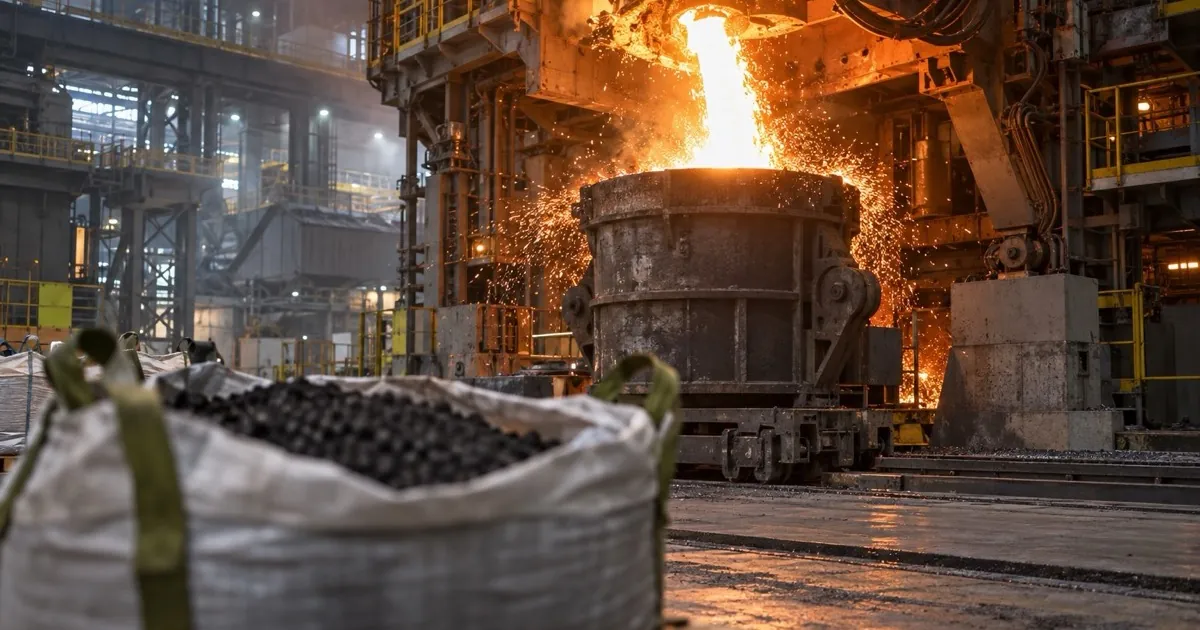
Biocoal for steelmaking has moved from pilot projects to purchasing agendas. With CBAM now in its definitive phase and free EU ETS allowances shrinking every year, every tonne of fossil coke, anthracite or coal that a steel plant can swap for renewable carbon has a direct cost effect. This guide explains where biochar for steel actually works, why its carbon is counted as zero-emission, and how to organise a trial without risking production.
Why steelmakers are looking for coal substitutes now
For years, decarbonisation in the steel industry was mostly a reporting exercise. That changed on 1 January 2026, when the EU Carbon Border Adjustment Mechanism (CBAM) entered its definitive phase. Importers of iron and steel, as well as aluminium, cement, fertilisers, hydrogen and electricity, now have to pay for the emissions embedded in their goods by surrendering CBAM certificates.
At the same time, free allocation under the EU ETS for these sectors is being phased out step by step between 2026 and 2034. European producers will pay for a growing share of their Scope 1 emissions, and exporters to the EU will see the same carbon cost at the border. In both cases, the fossil carbon used as a reductant or charge material is one of the largest and most direct sources of emissions.
That is why buyers are asking a practical question: which part of our coke, anthracite and coal consumption can be replaced with renewable carbon today, without changing the furnace or the steel grade?
Where biocoal can replace fossil carbon
Biocoal is not a universal drop-in for every application. Its substitution level depends on the process, the mechanical load on the carbon and the furnace design. The table below summarises where calcined biocarbon is used as a coke replacement and how far substitution typically goes.
| Process | Fossil carbon used | Role of biocarbon | Substitution level |
|---|---|---|---|
| Electric arc furnace (EAF) — charge carbon | Anthracite, coke breeze | Carbon carrier in the scrap charge, adjusts carbon content of the melt | Full, in many cases |
| EAF — slag foaming injection | Anthracite, petroleum coke | Injected fines react with FeO to foam the slag and protect refractories | Full or partial, depending on fraction |
| Blast furnace — PCI | Pulverised coal | Partial replacement of injected coal at the tuyeres | Partial, after trials |
| Blast furnace — nut coke | Small-size coke mixed with ore | Partial replacement where mechanical strength allows | Partial, after trials |
| Ferroalloys / ferrochrome in submerged arc furnaces (SAF) | Metallurgical coke, coal | Renewable reducing agent; higher electrical resistivity can help furnace operation | Partial, after trials |
In the EAF route, biochar in the electric arc furnace is the most straightforward option: charge carbon and injection carbon do not carry a burden, so strength matters less than chemistry and particle size. In the blast furnace and in ferrochrome smelting, the reductant also has to withstand load and abrasion, which is why substitution there is partial and always confirmed by trials. You can see the full range of uses on our biocarbon applications in metallurgy page.
Why biocarbon is counted as zero-emission
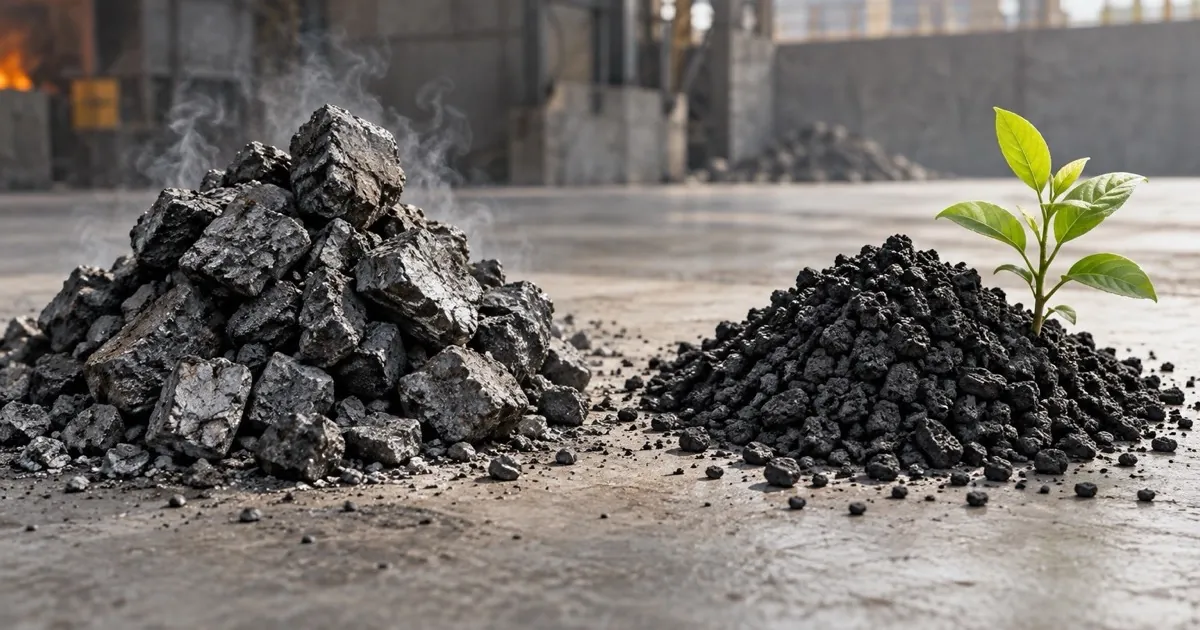
The carbon in biocoal comes from plants that absorbed CO₂ from the atmosphere during their growth. When this biogenic carbon is oxidised in a furnace, it releases the same CO₂ back, without adding fossil carbon to the cycle. Under EU ETS rules, emissions from sustainable biomass are counted as zero-emission (climate-neutral), so every tonne of fossil reductant replaced reduces the reported emissions of the plant.
According to independent research, replacing fossil coal with biochar can cut specific CO₂ emissions per tonne of steel by 70–90% in the processes where it is applied. The actual figure for a given plant depends on the substitution level and the route, but the direction is clear: less fossil carbon means fewer allowances to buy and a lower embedded-emission figure in CBAM declarations.
Key point: the zero-emission status depends on the biomass being sustainable. Pamecarbon uses only agricultural production waste, not wood, so there is no deforestation risk and feedstock origin documents are available on request.
Residues that would otherwise decompose and release CO₂ are turned into stable carbon, which makes our production carbon negative. For a deeper look at the terminology, read our article on calcined biocarbon vs biochar vs biocoal.
What a steel plant should check in metallurgical biochar
Not every biochar is suitable for steel. Agricultural biochar often has high volatile matter, variable ash and unpredictable chemistry. For a metallurgical reductant, the key parameters are:
- Fixed carbon — 85–95% for calcined biocarbon, from 80% for sulphur-free and phosphorus-free grades.
- Phosphorus — causes cold shortness (brittleness) in steel and passes from the reductant into ferroalloys, where it is expensive to remove.
- Sulphur — forms FeS, causes hot shortness and lowers ductility.
- Volatiles, ash and moisture — should be minimal and stable from batch to batch.
- Particle size — from 0–3 mm for injection up to 25–50 mm for lump applications; non-standard fractions on request.
Pamecarbon offers calcined biocarbon, low-phosphorus and sulphur-free grades, and biocoal for metallurgy. See the details on our calcined biocarbon products page.
Why so few producers can supply steel-grade biocoal
Making biochar is relatively simple. Making a calcined biocarbon with consistent properties at industrial volume is not. Calcination drives off most of the remaining volatile matter, raises fixed carbon and makes the material behave predictably in the furnace — but it requires high temperatures, precise process control and a stable feedstock stream.
This is why the market for biocoal for steelmaking is still supply-constrained. Many plants that want to cut CBAM exposure struggle to find a supplier that can deliver the same specification every month, with full lab documentation, at volumes beyond a few test bags. Terminology adds to the confusion: the same product is called biochar, biocoal, biocarbon or bio-coke, depending on who writes the specification.
For a steel plant, consistency matters more than a single good lab result. A reductant that varies in volatiles or ash from one shipment to the next forces operators to re-adjust carbon additions and slag practice, which quickly erodes the savings. When you evaluate a biocoal supplier, ask not only for a typical analysis but for CoAs from several consecutive batches, and check whether the producer can hold that specification at the monthly volume you will eventually need.
How to run a biocoal trial in your plant
A structured trial keeps risk low and gives your technologists data they can trust. We recommend the following steps:
- Define the application. EAF charge carbon, slag foaming, PCI or ferroalloy reductant — each needs a different fraction and specification.
- Request samples. We ship 2–5 kg within 5–7 business days, together with lab data.
- Check the Certificate of Analysis. Every batch comes with an independent CoA covering fixed carbon, volatile matter, ash, moisture, sulphur, phosphorus and calorific value.
- Run a small industrial batch. The minimum first order is one container (20 t), packed in big bags of 500–1000 kg, 25 kg bags or in bulk.
- Scale up. After a successful trial, regular shipments from 1 to several hundred tonnes per month are possible, including long-term contracts with fixed volume and price.
We produce in Kavak, Samsun, Türkiye, and export through the seaports of Samsun and Istanbul, delivering anywhere in Europe by sea, rail or road in about a week. Our customers are in Germany, France, the United Kingdom, the Netherlands, Belgium, Switzerland and Portugal. For purchasing details, read our guide to buying biochar in bulk.
Ready to test biochar for steel in your process? Request samples and a CoA — we will propose the right grade and fraction for your furnace.
Frequently asked questions
Can biocoal fully replace coke in steelmaking?
In EAF charge carbon and slag foaming, biocoal can often replace anthracite or coke completely. In blast furnaces and ferrochrome submerged arc furnaces, substitution is partial and depends on furnace design and trial results.
How does biochar for steel reduce CBAM and EU ETS costs?
Carbon from sustainable biomass is counted as zero-emission under EU ETS rules. Replacing fossil reductants lowers reported Scope 1 emissions, which reduces the allowances a plant must buy and the embedded emissions declared under CBAM.
What fixed carbon content does Pamecarbon biocoal have?
Calcined biocarbon has 85–95% fixed carbon, sulphur-free and phosphorus-free grades from 80%. Exact values for each batch are given in the Certificate of Analysis.
How can we start a trial?
Request 2–5 kg of samples, which we ship within 5–7 business days with lab data. After lab checks, the next step is a first order of one 20 t container for an industrial trial.